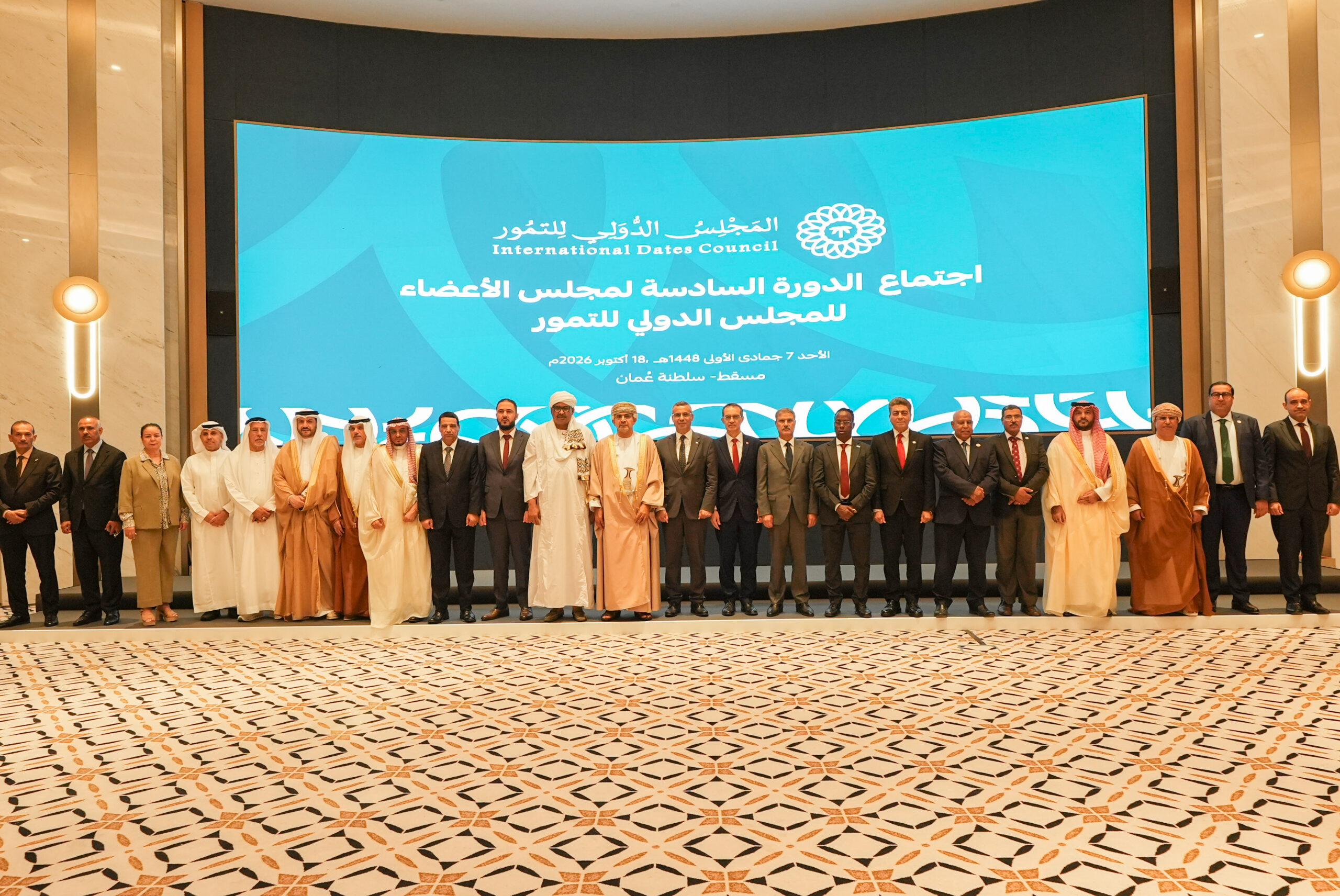
The International Dates Council convened today the sixth session of its Council of Members in Muscat, the capital of the Sultanate of Oman. The session was hosted by the Sultanate of Oman, represented by the Ministry of Agriculture, Fisheries and Water Resources, with the participation of representatives of the Council’s member states.
The meeting resulted in the election of the Executive Board for the upcoming term, the adoption of a mechanism for calculating the financial contributions of member states, and the extension of the mandates of the specialized committees. The Council also welcomed the accession of the Kingdom of Morocco and the State of Libya to its membership.
The meeting began with a review of the annual report on the activities of the Executive Secretariat, highlighting the key achievements, programs, and activities implemented during the previous period. It also reviewed progress in joint initiatives and projects and discussed strategic directions and priorities related to the development of the date palm and dates sector at the regional and international levels.
The session witnessed the election of the Executive Board for the upcoming term, with the Kingdom of Saudi Arabia continuing to hold the presidency. The Sultanate of Oman was selected to represent the Gulf States and Yemen region, the Hashemite Kingdom of Jordan to represent the Near East region, and Libya to represent the North Africa region.
The Council also expressed its appreciation to the members of the previous Executive Board, namely the Kingdom of Saudi Arabia, the Sultanate of Oman, Tunisia, and Palestine, in recognition of their efforts during the previous term.
The Council welcomed the accession of the Kingdom of Morocco and Libya to its membership, thereby expanding the geographical representation of member states and supporting opportunities for cooperation, knowledge exchange, and the development of joint initiatives in the date palm and dates sector.
At the financial and organizational levels, the Council of Members approved a mechanism for calculating member states’ financial contributions to the Council’s budget. This mechanism will help regulate the Council’s financial resources and support the sustainability of its programs and projects.
The Council also approved extending the mandates of the specialized committees for an additional term, enabling them to complete their tasks and technical programs and benefit from the accumulated expertise in their respective areas of specialization.
In his address, His Excellency Eng. Abdulrahman bin Abdulmohsen AlFadley, Minister of Environment, Water and Agriculture and Chair of the Council of Members of the International Dates Council, commended the Sultanate of Oman for hosting the sixth session. He emphasized the importance of moving from planning to the implementation of strategic initiatives and maximizing the economic value of the dates sector.
His Excellency stated that the date palm and dates sector is currently undergoing an important phase of transformation that goes beyond increasing production to maximizing value, enhancing competitiveness, developing markets and industries, and promoting sustainability.
Amid these transformations, the sector possesses significant potential to contribute to strengthening food security, supporting agricultural sustainability, improving resource-use efficiency, and creating sustainable economic and development opportunities. This reinforces the position of dates as a food and economic sector of growing global importance.
His Excellency explained that the global dates sector has experienced increasing growth over the past five years, with exports rising by approximately 6%, driven by changing consumption patterns and growing demand for food products with recognized health value.
He noted that this represents a strategic opportunity for the International Dates Council to link the capacities and expertise of its member states with the growth in global demand and to capitalize on their collective position, as they account for approximately 60% of global date production, with an annual output of nearly six million tonnes.
This would enhance the Council’s role in developing production, processing, and marketing, and in improving the competitiveness of dates and date products in global markets.
His Excellency further stated that, since its establishment and with the support and cooperation of its member states, the Council has achieved numerous accomplishments. It has worked to translate the decisions of the Council of Members into practical and operational measures that have contributed to the development of the date palm and dates sector at various levels.
He emphasized that the adoption of the strategic plan during the extraordinary meeting held in the first quarter of this year represented an important step toward establishing a clear framework to guide the Council’s work, determine its priorities for the coming phase, and move from planning to implementation and from objectives to tangible results.
He added that the current session builds upon these efforts by adopting decisions that enable the Council to perform its role more effectively and transform the objectives of the strategic plan into practical outcomes that open new horizons for the growth of the global dates sector in the areas of production, processing, and marketing.
His Excellency stressed that achieving these objectives requires greater cooperation and coordination, the exchange of expertise and experience, and the unification of efforts within the framework of the Council’s work and strategic priorities.
For her part, Her Royal Highness Princess Sarah bint Bandar bin Abdulaziz, Executive Director of the International Dates Council, stated in a speech delivered via videoconference that the Council aspires to become a trusted international reference for knowledge and standards, as well as a platform where the expertise of member states is integrated and their interests converge, making cooperation a pathway for the growth and enhanced competitiveness of the dates sector.
Her Royal Highness explained that the Council is committed to ensuring that the needs of member states form the basis for selecting its projects and determining its priorities. She added that the success of its programs should be measured by the value they add to the capacities of member states and the opportunities they create for date producers and exporters in international markets.
His Excellency Dr. Saud bin Hamoud Al Habsi, Minister of Agriculture, Fisheries and Water Resources of the Sultanate of Oman, emphasized the importance of the date palm and dates sector in achieving food security, supporting economic development, and sustaining rural communities.
He highlighted the need to develop value chains, improve quality, processing, and marketing, promote innovation, and expand private-sector participation in joint projects.
The session addressed ways to develop research, investment, and trade partnerships, facilitate the exchange of expertise and modern technologies, and provide data and indicators related to production and markets.
It also discussed strengthening cooperation in the fields of standards, quality, food safety, and access to international markets, thereby contributing to enhancing the global competitiveness of dates.
Representatives of the member states emphasized the importance of continuing joint efforts and implementing the decisions issued by the meeting in a manner that strengthens the Council’s institutional role and supports the achievement of its strategic objectives.

 Council News
 Oct 18, 2026
 Muscat