
Princess Sara bint Bandar Congratulates Dr. Khalid Hitimi on His Appointment as Morocco’s Minister of Agriculture
Princess Sara bint Bandar Congratulates Dr. Khalid Hitimi on His Appointment as Morocco’s Minister of Agriculture
Read more Council News
 Oct 22, 2026
 Muscat
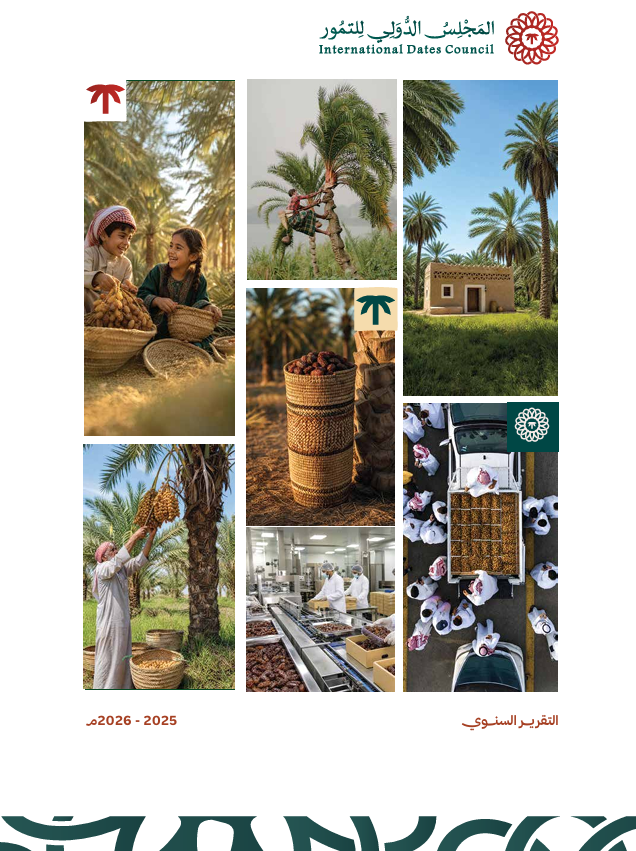
During its sixth session, held in Muscat, the International Dates Council reviewed its key achievements and programs for 2025 and 2026, the progress made in implementing its strategic plan, and its future directions aimed at enhancing the competitiveness, sustainability, and global market presence of the date palm and dates sector.
The Council’s annual report stated that global date production amounts to approximately 10 million tons annually, while global imports total around 1.9 million tons, with a value exceeding USD 2.6 billion. The Council comprises 17 Member States that collectively account for approximately 60% of global date production, with exports valued at nearly USD 1.5 billion.
The Council expanded its membership with the accession of two new countries. It also engaged with several countries to explore opportunities for membership and cooperation. Furthermore, it strengthened its international presence by obtaining observer status with the Codex Alimentarius Commission and advancing its cooperation with the Food and Agriculture Organization of the United Nations, the International Olive Council, and several specialized organizations.
The Council’s achievements included participating in international exhibitions and trade platforms, preparing studies on markets and competitiveness, and publishing the Global Date Market study in both Arabic and English. It also signed the International Dates Observatory Agreement with the Kingdom of Bahrain, conducted training courses and workshops in several Member States, and signed a memorandum of understanding to establish a specialized Dates Academy in the Kingdom of Morocco.
As part of its efforts to strengthen its partnership with the private sector, the Council established a specialized committee comprising representatives of companies and organizations from Member States. It also organized consultative meetings and workshops to identify challenges and investment opportunities, developed a governance framework for its relationship with the private sector, and entered into a partnership agreement with Milaf.
The report indicated that the Council achieved an overall performance rate of 67% in implementing its strategic plan, which is built on five pillars: international reference and recognized standards; added value and global demand; knowledge and data systems; partnerships and financial sustainability; and institutional governance. The Council also implemented or participated in 27 international events, prepared 15 studies and knowledge products, and organized 15 workshops and lectures that benefited approximately 3,200 participants.
At the institutional level, the Council worked to develop its governance framework and operating model, update its policies and procedures, strengthen financial oversight, digitize its administrative processes, and launch its new visual identity. The number of followers across its digital platforms also increased by 119% within one year, reaching 5,491 followers.
In the next phase, the Council will move forward with implementing its 2026–2030 Strategy, which focuses on developing data and indicators, strengthening technical cooperation, supporting trade, innovation, and value-added industries, improving the quality and competitiveness of dates, and expanding their access to global markets. To view the full report, please visit the following link: https://intdc.org/wp-content/uploads/2026/10/report2026-v-v201.pdf
Princess Sara bint Bandar Congratulates Dr. Khalid Hitimi on His Appointment as Morocco’s Minister of Agriculture
Read more