
 Council News
International Dates Council Organizes an Extension Lecture on the Impact of Horticultural Practices on Date Yield and Quality
-
 Sep 18, 2024
-
 Cairo
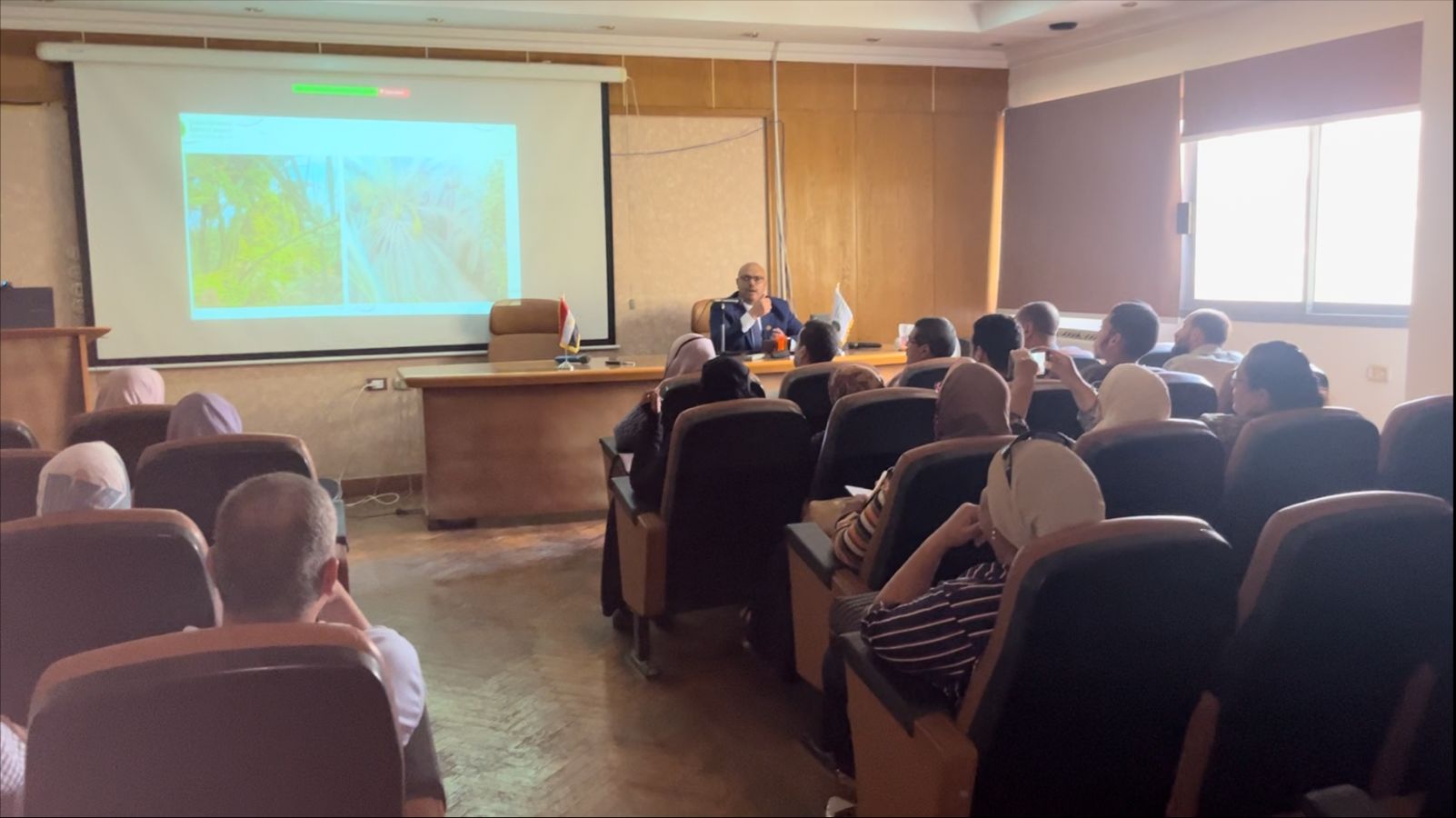
The International Dates Council organized an extension lecture entitled “The Impact of Horticultural Practices on Date Palm Productivity and Date Yield Quality,” delivered by the Council’s expert, Professor Hossam Metwally. The lecture was held in a hybrid format, combining in-person attendance at the auditorium of the Central Laboratory for Date Palm Research and Development in the Arab Republic of Egypt with virtual participation via Zoom.
The lecture was organized as part of the Council’s efforts to disseminate technical and extension knowledge, promote the exchange of expertise among researchers, specialists, and farmers, and support agricultural practices that contribute to developing date palm cultivation and improving productivity and crop quality.
The lecture addressed the impact of several essential horticultural practices on the quantity and quality of the date crop, foremost among them pruning, pollination, thinning, bunch bending, and bagging. It also reviewed the importance of carrying out these practices at the appropriate times and in accordance with suitable technical methods.
Professor Hossam Metwally reviewed the role of pruning in improving date palm growth, regulating frond distribution, and facilitating agricultural operations, thereby helping to create suitable conditions for fruit development and improved crop quality.
The lecture also addressed the importance of pollination as one of the key practices affecting fruit set and production volume, emphasizing the need to select appropriate pollen sources and carry out pollination at the proper time to achieve the desired results.
The lecture discussed fruit thinning and its impact on achieving a balance between crop quantity and quality. Regulated thinning contributes to improving fruit size and characteristics and reducing excessive loads on the date palm, thereby supporting production continuity and enhancing the market value of dates.
The lecture also discussed bunch bending and bagging and their role in protecting fruit bunches and fruits, improving their exposure to suitable environmental conditions, and reducing potential damage caused by pests or weather conditions, thereby helping to preserve crop integrity and improve its quality.
The lecture emphasized the importance of integrating the various horticultural practices rather than treating them as separate operations, given their direct relationship with date palm growth, fruit development, production volume, and crop quality.
The hybrid format of the lecture provided an opportunity to broaden participation and enable interested individuals and specialists to follow its content and benefit from the technical information and recommendations presented, in addition to exchanging views and expertise on best practices in date palm cultivation and management.
This lecture forms part of the International Dates Council’s programs aimed at supporting agricultural extension, promoting the transfer of knowledge and research findings to professionals working in the sector, and improving the efficiency of horticultural practices, thereby contributing to increased date palm productivity, improved date quality, and enhanced competitiveness in local and international markets.